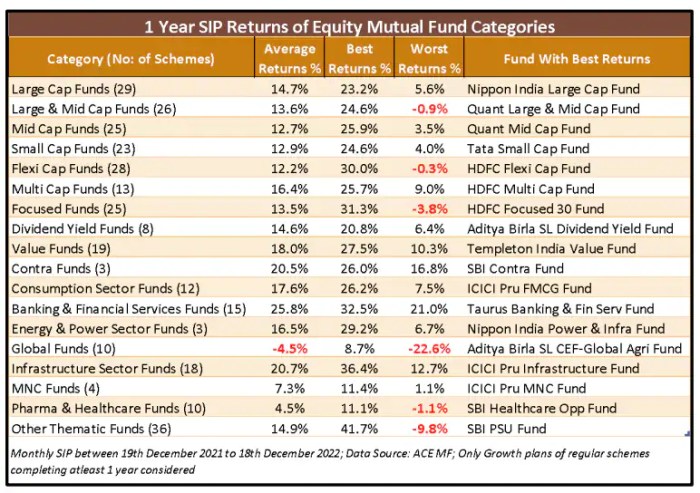
SIP performance in mutual funds sets the stage for this enthralling narrative, offering readers a glimpse into a story that is rich in detail with casual formal language style and brimming with originality from the outset.
As we delve deeper, we will uncover the intricacies of SIP performance in mutual funds and explore the factors that play a pivotal role in shaping investment outcomes.
Overview of SIP Performance in Mutual Funds

SIP performance in mutual funds refers to how well an investment made through a Systematic Investment Plan (SIP) has performed over a specific period of time. SIP allows investors to regularly invest a fixed amount in a mutual fund scheme, typically on a monthly basis, to achieve long-term financial goals.
The significance of SIP performance lies in its ability to help investors build wealth over time through disciplined and regular investments. By investing a fixed amount at regular intervals, investors benefit from the power of compounding and rupee cost averaging, reducing the impact of market volatility on their investments.
Measurement and Evaluation of SIP Performance
When evaluating the performance of SIP investments in mutual funds, several key metrics are considered:
- Annualized Returns: This metric calculates the average annual return earned by the SIP investment over a specific period. It provides a standardized way to compare the performance of different mutual fund schemes.
- Volatility: Volatility measures the fluctuation in the returns of the SIP investment. Lower volatility indicates a more stable performance, while higher volatility suggests greater risk.
- Sharpe Ratio: The Sharpe ratio evaluates the risk-adjusted return of the SIP investment. A higher Sharpe ratio indicates better risk-adjusted performance.
- Rolling Returns: Rolling returns analyze the SIP investment’s performance over various holding periods, providing insights into its consistency and long-term growth potential.
Factors Influencing SIP Performance
When considering the performance of Systematic Investment Plans (SIPs) in mutual funds, it is essential to take into account various factors that can influence their overall performance. These factors play a crucial role in determining the returns and success of SIP investments.
Market Conditions
Market conditions have a significant impact on the performance of SIPs in mutual funds. Fluctuations in the stock market, economic indicators, geopolitical events, and other external factors can affect the value of investments. During bull markets, SIPs may perform well due to rising stock prices, while in bear markets, returns may be lower or negative.
Role of Fund Managers
Fund managers play a vital role in influencing the performance of SIPs in mutual funds. Their expertise, investment strategies, and decision-making skills can determine the success of the fund. Fund managers analyze market trends, select appropriate securities, and make buy or sell decisions to maximize returns for investors.
Comparison of SIP Performance Across Different Fund Types
When comparing SIP performance across different fund types, it’s important to look at how equity mutual funds stack up against debt mutual funds.
Equity Mutual Funds vs. Debt Mutual Funds
Equity mutual funds typically invest in stocks, offering higher growth potential but also higher volatility compared to debt mutual funds, which invest in fixed-income securities like bonds. As a result, SIP performance in equity mutual funds may fluctuate more significantly over time compared to debt mutual funds.
Large-Cap, Mid-Cap, and Small-Cap Funds
- Large-cap funds focus on established companies with stable growth potential, offering lower but more consistent returns. SIP performance in large-cap funds may be less volatile compared to mid-cap and small-cap funds.
- Mid-cap funds invest in companies with moderate growth potential, offering a balance between risk and return. SIP performance in mid-cap funds may show more fluctuations compared to large-cap and small-cap funds.
- Small-cap funds target smaller companies with high growth potential but also higher risk. SIP performance in small-cap funds can be more volatile and may offer the potential for higher returns over the long term.
Actively Managed vs. Passively Managed Funds
Actively managed funds have fund managers making investment decisions to outperform the market, potentially leading to higher returns but also higher fees. SIP performance in actively managed funds may vary based on the manager’s skill and market conditions.
Passively managed funds, like index funds, aim to replicate the performance of a specific market index, offering lower fees but potentially lower returns. SIP performance in passively managed funds may be more consistent and closely track the index they are following.
Strategies to Improve SIP Performance
Investors can implement various strategies to enhance SIP performance in mutual funds. One key aspect to focus on is asset allocation, which involves dividing investments among different asset classes such as equities, bonds, and cash equivalents. Proper asset allocation can help manage risk and optimize returns over the long term.
Importance of Asset Allocation
Asset allocation plays a crucial role in improving SIP performance as it helps investors create a well-balanced portfolio that aligns with their financial goals and risk tolerance. By diversifying investments across different asset classes, investors can reduce the impact of market volatility on their portfolio. For example, during market downturns, having a mix of equities and bonds can help mitigate losses and provide stability.
Impact of Diversification
Diversification is another key strategy to enhance SIP performance in mutual funds. By spreading investments across various sectors, industries, and geographical regions, investors can minimize concentration risk and increase the potential for higher returns. Diversification helps to ensure that the performance of one asset does not significantly impact the overall portfolio. It is essential to regularly review and rebalance the portfolio to maintain the desired asset allocation and diversification.
Fund Performance
Fund performance refers to the measure of how well a mutual fund has performed over a specific period. It is a crucial factor for investors as it indicates the ability of the fund to meet its investment objectives and provide returns.
Significance of Fund Performance for Investors
Fund performance is evaluated and compared within the mutual fund industry using various metrics such as annualized returns, volatility measures like standard deviation, Sharpe ratio, and benchmark comparisons. These metrics help investors gauge the fund’s risk-adjusted returns and compare it with other funds in the same category.
Relationship Between Fund Performance and Investor Returns
The performance of a fund directly impacts the returns received by investors. A fund with strong performance usually generates higher returns for investors, while a fund with poor performance may lead to lower returns or even losses. It is essential for investors to closely monitor fund performance to make informed investment decisions.
In conclusion, the discussion on SIP performance in mutual funds sheds light on the nuances of this essential aspect of investing, paving the way for informed decisions and strategic financial planning.
Clarifying Questions
What is SIP performance in mutual funds?
SIP performance in mutual funds refers to the measurement of Systematic Investment Plan (SIP) returns within mutual fund investments.
How is SIP performance evaluated?
SIP performance is evaluated based on the returns generated over a specific period through regular investments at fixed intervals.
What factors influence SIP performance?
Key factors impacting SIP performance include market conditions, fund management strategies, and asset allocation.
Can SIP performance vary across different fund types?
Yes, SIP performance can vary between equity and debt mutual funds, as well as among different fund categories like large-cap, mid-cap, and small-cap.
How can investors improve SIP performance?
Investors can enhance SIP performance by implementing strategies like proper asset allocation and diversification in their mutual fund portfolios.


