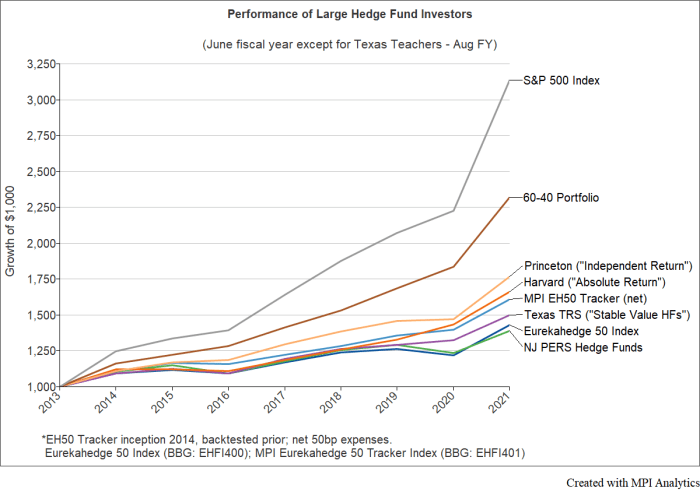
Fund performance benchmarks set the stage for this enthralling narrative, offering readers a glimpse into a story that is rich in detail and brimming with originality from the outset. In the world of investments, understanding how these benchmarks work is crucial for making informed decisions and maximizing returns.
As we delve deeper into the realm of fund performance benchmarks, we uncover a treasure trove of knowledge that sheds light on the intricacies of evaluating investment funds and the factors that influence their performance.
Fund Performance Benchmarks Overview
When it comes to evaluating the success of investment funds, fund performance benchmarks play a crucial role in the investment industry. These benchmarks act as a standard for comparing the performance of different funds and assessing their overall success.
Types of Fund Performance Benchmarks
- Market Index Benchmarks: These benchmarks track the performance of a specific market index, such as the S&P 500 or Dow Jones Industrial Average. Investors use these benchmarks to gauge how well a fund is performing relative to the broader market.
- Peer Group Benchmarks: These benchmarks compare a fund’s performance to other funds in the same category or peer group. This helps investors understand how a fund stacks up against its competitors.
- Absolute Return Benchmarks: These benchmarks focus on achieving a positive return regardless of market conditions. They are commonly used in alternative investments and hedge funds.
Examples of well-known fund performance benchmarks include the S&P 500, which tracks the performance of 500 large-cap U.S. stocks, and the Dow Jones Industrial Average, which follows the performance of 30 key U.S. companies.
Key Metrics for Evaluating Fund Performance
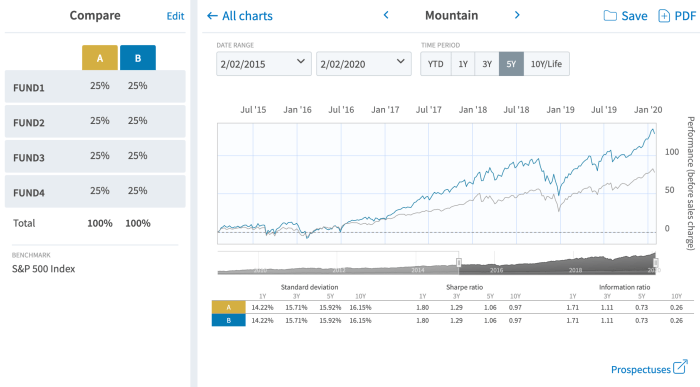
Investors and fund managers rely on several key metrics to evaluate the performance of investment funds against benchmarks. These metrics provide valuable insights into the fund’s returns, risk profile, and overall performance.
Return on Investment (ROI)
Return on Investment (ROI) is a fundamental metric used to assess the profitability of an investment relative to its cost. It is calculated by dividing the net profit generated by an investment by the initial cost of the investment. A higher ROI indicates better performance and efficiency in generating returns for investors.
Standard Deviation
Standard Deviation measures the dispersion of returns around the average return of a fund. It provides insights into the volatility and risk associated with an investment. A higher standard deviation implies higher volatility and risk, while a lower standard deviation indicates more stable returns. Fund managers use standard deviation to evaluate the consistency and stability of a fund’s performance.
Sharpe Ratio
The Sharpe Ratio is a risk-adjusted measure that evaluates the return of an investment relative to its risk. It takes into account both the return on investment and the volatility of returns, providing a more comprehensive assessment of performance. A higher Sharpe Ratio indicates better risk-adjusted returns, reflecting the efficiency of the fund in generating returns relative to the level of risk taken.Fund managers utilize these metrics to make informed investment decisions and monitor the performance of their funds over time.
By analyzing ROI, standard deviation, and Sharpe Ratio, fund managers can assess the risk-return profile of their investments, identify areas for improvement, and make adjustments to optimize the performance of the fund.
Factors Influencing Fund Performance
When evaluating a fund’s performance relative to benchmarks, it’s important to consider a variety of factors that can have a significant impact. These factors can range from market conditions to fund management strategies, all of which play a crucial role in determining the fund’s overall performance.
Market Conditions
Market conditions, such as volatility, interest rates, and overall economic stability, can greatly influence a fund’s performance. For example, during periods of high volatility, funds with higher risk exposures may experience greater fluctuations in performance compared to more conservative funds.
Economic Factors
Economic factors like inflation rates, GDP growth, and unemployment levels can also affect fund performance. For instance, a fund heavily invested in a specific industry may see its performance impacted by changes in that industry’s overall health and growth prospects.
Fund Management Strategies
The strategies employed by fund managers, such as asset allocation, diversification, and active versus passive management, can significantly impact fund performance relative to benchmarks. For example, a fund manager who actively trades securities may outperform a benchmark in a rising market but underperform in a declining market.
External Factors
External factors like geopolitical events, regulatory changes, or industry trends can also play a role in influencing fund performance benchmarks. For instance, a sudden shift in government policies or a major industry disruption can lead to significant fluctuations in a fund’s performance compared to its benchmark.
Benchmark Selection and Implementation
Selecting appropriate benchmarks for different types of investment funds is a crucial step in evaluating fund performance. Benchmarks serve as a point of reference to assess how well a fund is performing relative to a specific market or asset class. By comparing a fund’s returns against a relevant benchmark, investors can gauge the fund manager’s skill and make informed decisions about their investments.
Process of Benchmark Selection
- Identify the investment strategy: Different types of investment funds have varying objectives and strategies. It is essential to choose a benchmark that closely aligns with the fund’s investment approach.
- Evaluate market representation: The benchmark should accurately represent the market or asset class in which the fund invests. This ensures a meaningful comparison of performance.
- Consider risk factors: Take into account the risk profile of the fund when selecting a benchmark. A benchmark with similar risk characteristics can provide a more accurate assessment of performance.
Setting Realistic Performance Expectations
- Benchmarking helps investors set realistic performance expectations by offering a standard for comparison. It allows investors to understand how their fund is performing relative to a designated benchmark, providing a basis for evaluating success.
- Investors can use benchmarking to assess whether their fund is meeting its objectives and delivering returns that justify the associated risks. It helps in managing expectations and making informed decisions about fund allocations.
Challenges in Benchmark Implementation
- Availability of appropriate benchmarks: Finding suitable benchmarks that accurately represent a fund’s investment strategy and market exposure can be challenging, especially for specialized or niche funds.
- Data accuracy and consistency: Ensuring that benchmark data is reliable and consistent over time is crucial for meaningful performance comparisons. Discrepancies or errors in benchmark data can lead to inaccurate assessments.
- Tracking error and attribution: Monitoring the tracking error between a fund and its benchmark can help identify the impact of active management decisions. Understanding the sources of performance deviation is essential for evaluating fund manager skill.
In conclusion, fund performance benchmarks serve as a compass in the vast sea of investment opportunities, guiding investors towards achieving their financial goals. By grasping the significance of these benchmarks and the metrics used to measure success, individuals can navigate the complex landscape of investments with confidence and clarity.
Commonly Asked Questions
How do fund performance benchmarks impact investment decisions?
Fund performance benchmarks provide a standard for measuring the success of investment funds, helping investors evaluate performance and make informed decisions.
What are some common types of fund performance benchmarks?
Examples of well-known benchmarks include S&P 500 and Dow Jones Industrial Average, which are widely used in the investment industry.
How do external factors influence fund performance benchmarks?
External factors such as market conditions, economic changes, and geopolitical events can significantly impact fund performance relative to benchmarks.


