
Exploring the realm of Fund performance review tools, this introduction delves into the significance of evaluating fund performance in the financial sector. It highlights key metrics, tool types, and technological advancements that shape investment decisions.
As we navigate through the intricacies of fund performance evaluation, a deeper understanding of the tools and metrics used will be uncovered, shedding light on how these elements influence investment strategies.
FUND PERFORMANCE
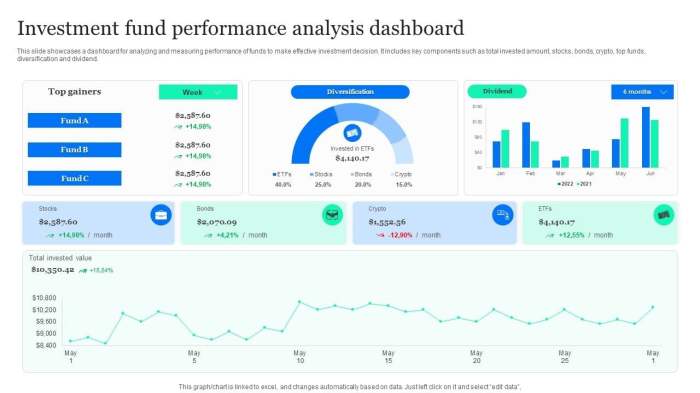
Fund performance evaluation plays a crucial role in the financial industry as it allows investors to assess the effectiveness of their investment decisions and helps them make informed choices for future investments. By analyzing the performance of various funds, investors can determine the profitability, risk levels, and overall success of their investment portfolios.
Key Metrics for Fund Performance Evaluation
- Return on Investment (ROI): This metric measures the profitability of an investment by calculating the percentage gain or loss relative to the initial investment.
- Sharpe Ratio: The Sharpe Ratio helps investors evaluate the risk-adjusted return of a fund and compare it to other investment options.
- Alpha: Alpha measures the excess return of a fund compared to its benchmark index, indicating the fund manager’s skill in generating returns.
- Standard Deviation: Standard deviation is a measure of the volatility or risk associated with an investment, helping investors understand the potential fluctuations in returns.
Impact of Fund Performance on Investment Decisions
Fund performance directly influences investment decisions by providing valuable insights into the historical returns and risk levels of a fund. Positive performance results can attract more investors, leading to increased fund inflows, while poor performance may result in investors withdrawing their investments. Additionally, fund performance data helps investors identify trends, opportunities, and potential risks, guiding them in making strategic investment decisions for achieving their financial goals.
FUND PERFORMANCE REVIEW TOOLS
When it comes to evaluating fund performance, there are several tools available in the market that can assist investors and fund managers in making informed decisions.
Types of Fund Performance Review Tools
There are two main types of fund performance review tools:
- Automated tools: These tools use algorithms and data analysis to quickly assess fund performance based on preset criteria.
- Manual methods: This involves a more hands-on approach where individuals analyze fund performance data and make evaluations based on their expertise.
Comparison of Automated Tools vs. Manual Methods
Automated fund performance evaluation tools offer the advantage of speed and efficiency in analyzing large volumes of data. They can quickly identify trends and patterns that may not be immediately apparent to human analysts. On the other hand, manual methods allow for a more nuanced evaluation that takes into account qualitative factors that automated tools may overlook.
Benefits of Using Fund Performance Review Tools
For investors, fund performance review tools provide transparency and insight into how their investments are performing. They can help investors make informed decisions about where to allocate their funds for optimal returns. For fund managers, these tools streamline the evaluation process and enable them to identify areas for improvement in their fund strategies.
METRICS AND INDICATORS
Investors and analysts utilize various performance metrics and indicators to assess the risk and return profile of a fund. These metrics provide valuable insights into how well a fund has performed relative to its benchmark and peers.Performance metrics such as Sharpe ratio, alpha, beta, standard deviation, and R-squared are commonly used to evaluate the risk-adjusted returns of a fund. The Sharpe ratio, for example, measures the excess return generated by a fund per unit of risk taken.
A higher Sharpe ratio indicates better risk-adjusted performance.On the other hand, alpha represents the excess return of a fund compared to the return expected for its level of risk, while beta measures the fund’s sensitivity to market movements. Standard deviation quantifies the volatility of returns, and R-squared indicates the percentage of a fund’s movements that can be explained by the movements in its benchmark.These metrics help investors and fund managers gauge the efficiency, risk exposure, and consistency of a fund’s performance.
By analyzing these indicators, stakeholders can make informed decisions regarding fund selection, portfolio construction, and risk management strategies.
Interpreting Fund Performance Indicators
- When a fund exhibits a higher Sharpe ratio, it signifies superior risk-adjusted returns compared to its peers.
- A positive alpha suggests that the fund has outperformed its expected return based on its risk level.
- A beta of 1 indicates that the fund moves in line with the market, while a beta greater than 1 signifies higher volatility.
- Lower standard deviation implies more stable returns, whereas a higher R-squared reflects greater correlation with the benchmark.
TECHNOLOGICAL ADVANCEMENTS
Technology has played a crucial role in shaping the development of fund performance review tools. Advancements in artificial intelligence (AI) and machine learning have significantly enhanced the efficiency and accuracy of fund performance analysis. These innovative technologies have revolutionized the way fund managers evaluate and monitor their investments, providing deeper insights and faster decision-making processes.
Role of Artificial Intelligence and Machine Learning
Artificial intelligence and machine learning algorithms have been instrumental in analyzing vast amounts of data to identify trends, patterns, and correlations that human analysts may overlook. These technologies can quickly process complex data sets, detect anomalies, and predict future market movements with a high degree of accuracy. By leveraging AI and machine learning, fund performance review tools can offer more sophisticated risk assessment and performance evaluation capabilities.
Examples of Innovative Technologies
One notable example of innovative technology in fund performance evaluation is the use of natural language processing (NLP) to analyze textual data from financial reports, news articles, and social media. NLP algorithms can extract valuable insights from unstructured data sources, providing fund managers with a comprehensive view of market sentiment and investor behavior. Additionally, the integration of blockchain technology has enabled secure and transparent tracking of fund transactions, ensuring data integrity and enhancing trust among investors.
In conclusion, Fund performance review tools play a pivotal role in empowering investors and fund managers to make informed decisions. By harnessing the capabilities of these tools, stakeholders can navigate the complex landscape of financial markets with precision and confidence.
FAQs
What are some key metrics used to assess fund performance?
Key metrics include Sharpe ratio, alpha, beta, etc., which offer insights into the risk and return profile of a fund.
How do fund performance review tools benefit investors and fund managers?
These tools provide automated evaluation, comparison with manual methods, and insights into enhancing performance, aiding in decision-making processes.
How have technological advancements impacted fund performance review tools?
Advancements like AI and machine learning have revolutionized these tools, offering innovative ways to analyze and interpret fund performance data.


